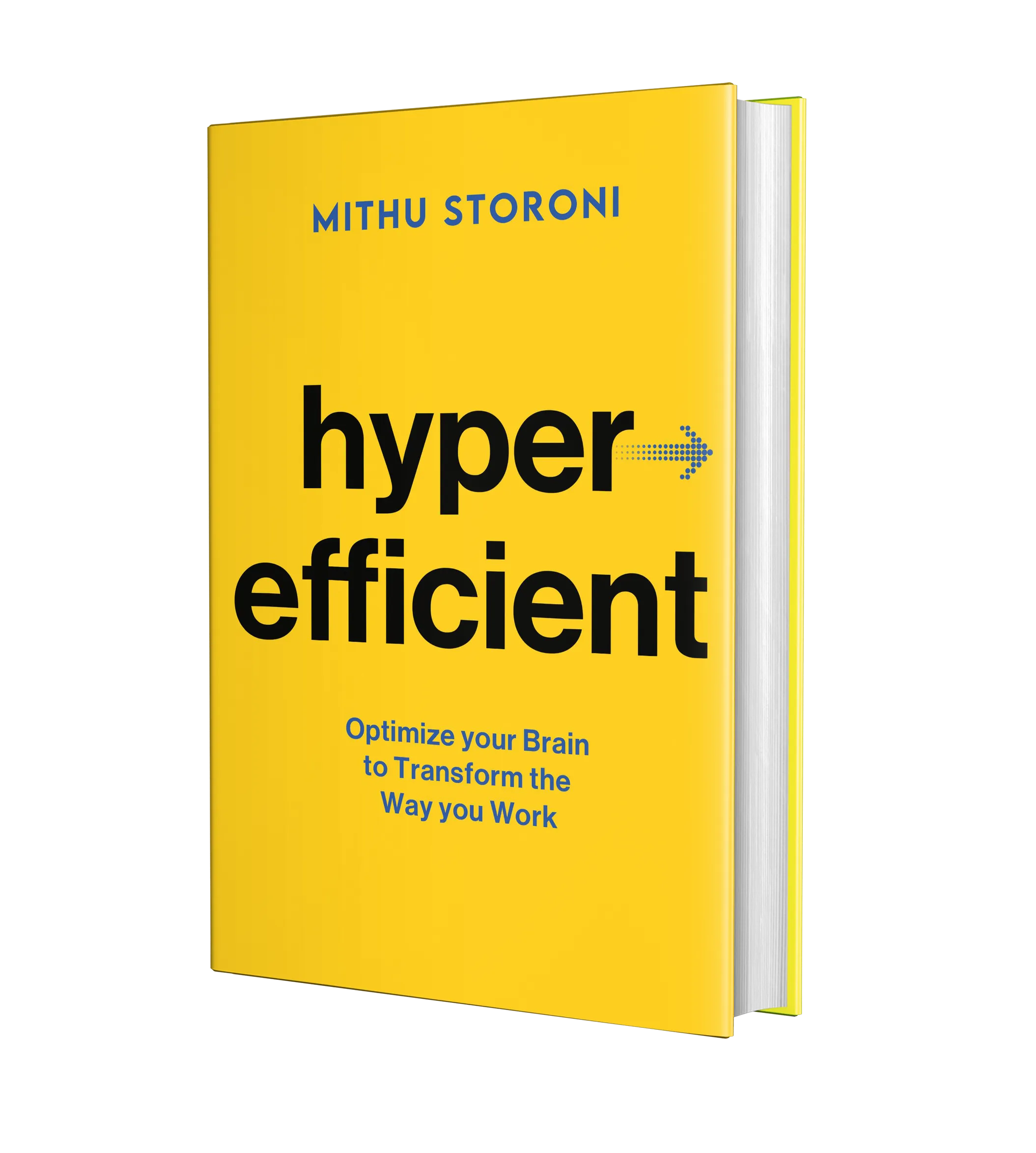
Hyperefficient
Optimize your brain to transform the way you work
How to think well in an age of relentless work and ambient technology — built on three principles drawn from peer-reviewed neuroscience.
The big idea
The way we work is breaking the way we think.
Most knowledge workers spend their days fighting their own brains. The 9-to-5 was designed for a kind of work that no longer exists — repeatable, paced, physical — and the cognitive demands of modern work sit awkwardly on top of it. The result is an entire class of workers who feel busier than ever and produce less of the thinking work they were hired for.
Hyperefficient is a tour through the neuroscience of how the brain actually performs, built around three principles for getting it to work at its best. Drawing on research from cognitive psychology, neurophysiology, and clinical medicine, it offers a practical framework for designing a day — and a working life — around how the mind was built to think.
Three principles
How the brain works at its best.
Get in gear
Cognitive momentum doesn't build in the wrong gear. Your brain drifts through many different mental states or "mental gears" all day long — from scattered and distracted, to calm and creative, from wired and anxious to deeply focused. Your brain does its best work in one specific gear at any given time. Most of us let these states happen passively, leaving the quality of our output to chance, but if you learn to recognize these states and master the skill of intentionally shifting into the right gear on demand, everything changes. You'll produce your highest-quality work consistently, not just when luck is on your side. Ideas will flow more freely, focused work will feel lighter, and you'll finish each day with more energy.
Run in rhythm
Your brain operates on biological rhythms. These rhythms create distinct windows of peak neurochemical states: some hours are optimal for deep focused execution and analytical thinking, while others are ideal for divergent thinking and generating insights. The industrial workday flattens these rhythms out, which is why so much knowledge work feels both exhausting and unproductive. If you align your tasks with these endogenous rhythms instead of forcing your brain to conform to arbitrary workplace schedules, you will sustain high-intensity work for longer, maintain higher output quality, reduce mental fatigue, and preserve energy reserves through to the end of the day.
Find your flame
The old goalposts are disappearing fast: job security, predictable career ladders, and clearly defined roles. To thrive in this new reality, you need a fresh kind of motivation, one that comes from within. The most reliable way to ignite your inner fire is by intentionally designing your work around learning, mastery, and measurable progress. When these three elements become your new compass, motivation stops being something you chase and starts becoming something you create.
Press appearances
Selected coverage.
- Newsweek Forget super-intelligence, hyper-efficiency is the real quest Read →
- HBR On Leadership Redefining what efficiency means in the age of AI Read →
- TIME The hidden gift of uncertainty in an age of technology Read →
- Harvard Business Review IdeaCast Training your brain to work more effectively Read →
- Bloomberg Businessweek Training your brain to be more efficient at work Read →
- Financial Times Business books: what to read this month Read →
- New Scientist Take control of your brain's master switch Read →
- The Times Power up: how to give your brain that extra boost it needs Read →
- Forbes Boost your personal efficiency: try these research-based tips Read →
- The Guardian Help! It turns out breaks make you more productive Read →
- Fortune How to hack your schedule for optimal mental state Read →
- Fast Company How to work more efficiently, according to a neuroscientist Read →
- Business Insider Three changes a neuroscientist made to take advantage of when her brain works best Read →
- Big Think Why hardwired 'power laws' hold the secret to better work Read →
- Inc. How to tell if you're born to be a leader, according to science
- Entrepreneur Three tips to make your brain more efficient Read →
Buy
Get the book.
Available wherever you prefer to buy.